It’s been officially calculated that counting to a million
aloud takes 5.2 hours, but I know for a fact that's wrong because I did it one
day when walking home from school in the 4th grade in about twenty
minutes.
Birney Elementary was 3,132 feet from my house in Long
Beach, CA and after spending most of the 3rd grade wheedling at my
Mom to let me walk to and from school, instead of being embarrassed to be
dropped off in front of the 6th graders, I got my wish at the start
of 4th grade. Unfortunately, it wasn’t long before I learned to
loathe every one of the 1,441 steps it took to get home. Like Oscar Wilde said,
“There are only two tragedies in life: when one doesn’t get what one wants, and
when one does.”
Even though my Mom made sure that I knew the route and
walked it with me in preparation the Sunday before the start of 4th
grade, it seemed so much farther the
first day I did it alone. I did not vary one inch from the prescribed course
for fear of losing my way, never to be found again. I still remembered missing
my bus stop in kindergarten, getting off only one stop later, probably not more
than two blocks from my home, and having no bearing at all as to which way I
should go, or how to even tell anyone where I lived. I sat down under a tree in
our Virginia suburb and cried until my Mom came and found me after seeing that
I didn’t get off the bus. So I stuck to the course she laid out for me in the
most rigid fashion, which is how I came to watch the Wedding of Luke and Laura
on General Hospital with a mysterious girl named Adrienne St. Clair.
 |
| Home sweet home |
The walk home along the route my Mom laid out was divided up
into distinct zones in my mind, with numbered streets running east-west and
named avenues running north-south. Birney Elementary lay at the corner of Maine
Avenue and Spring Street, so I walked south along Maine to 28th
Street, and then east down 28th to Cedar Avenue, then south down
Cedar to 2721. Home, sweet home. Five
blocks over, three blocks down, essentially an ersatz 'Z’. Six tenths of a
mile, 3,132 feet, 1,441 steps.
 The neighborhood seemed safe enough, what little I knew of
it, since my world was circumscribed by busy streets that I wouldn’t cross
without compelling reason. Spring and Willow Streets were my north-south boundaries,
and Magnolia and Pacific Avenues my east-west. Within that defined grid of
prewar stucco bungalows, I’d only ever run into trouble once. A teen had tried
to steal my bike out from under me, but a little old Korean lady came charging
out into the street almost instantly, brandishing a broom like a samurai sword,
screaming at the kid like a banshee and fearlessly charging him head on. He’d
naturally turned tail and run, never to be seen in our neighborhood again. So
the thing I took with me was not the attempted crime, but the sense that we
were all in it together and anyone that tried anything was gonna get it.
The neighborhood seemed safe enough, what little I knew of
it, since my world was circumscribed by busy streets that I wouldn’t cross
without compelling reason. Spring and Willow Streets were my north-south boundaries,
and Magnolia and Pacific Avenues my east-west. Within that defined grid of
prewar stucco bungalows, I’d only ever run into trouble once. A teen had tried
to steal my bike out from under me, but a little old Korean lady came charging
out into the street almost instantly, brandishing a broom like a samurai sword,
screaming at the kid like a banshee and fearlessly charging him head on. He’d
naturally turned tail and run, never to be seen in our neighborhood again. So
the thing I took with me was not the attempted crime, but the sense that we
were all in it together and anyone that tried anything was gonna get it.
Inside my little snow-globe universe, each avenue of the
trip had its own character, its own smells, and its own perceived threats. Most
notably were the two dogs that were constant terrors to me, Butler and Duke.
Butler lived on 28th, between Daisy and Magnolia; Duke also lived on
28th, but between Chestnut and Cedar. So the numbered streets seemed
like twilight borderlands where anything could happen.
I felt especially anxious about crossing Magnolia Avenue
because of the volume of traffic and higher speed limit, and would not traverse
it unless compelled to do so by scholastic imperative; never during play times
or even to visit a friend. Outside of my defined grid, it was as if nothing and
no one existed. Even within my grid I hated Eucalyptus Avenue because it smelled
funny, and Chestnut Avenue because it always seemed kind of sketchy. It was
overshadowed by huge trees whose roots pushed the sidewalks up into broken
jumbles and it was always dim, no matter how sunny the day was. Plus, on the
unpredictable occasions that Duke the German Shepherd came for me, it was
always at Chestnut and 28th.
 |
| The daily detour from my fixed route. |
In spite of all that, it never occurred to me to change my
course to avoid either of my canine nemeses because of my fear of losing my
way. Like there was only one way home and even the slightest deviation would divert
me into some alternate dimension I could never return from. I was held so
tightly in the grips of that anxiety that I refused to even walk on the
opposite side of the same street, brooking no deviations of any kind, for any
reason. So I stuck to my guns and brazened my way past Butler, the massive
Great Dane who stood on his hind legs behind his gate and snarled, barked, and
slobbered on you if you came within reach. And I just ran like hell when I saw
Duke.
Right up until the day that I didn’t.
I don’t know how many months I spent robotically plowing
through what felt like a trek across all of Middle Earth before Adrienne found
me, but it seemed like an eternity. Sometimes I would look down the length of a
street that seemed like it went out to the vanishing point and then dropped off
the edge of the Earth, and I could not imagine how I would ever make the
impossible journey. It just seemed so far and each step whittled away so
little. This feeling was perfectly captured for me years later in Freshman
philosophy class when I came across Zeno’s Paradox of Locomotion.
The ancient Greek philosopher said that in order to cross
any distance –say…3,132 feet– one must first complete the task of crossing the
halfway point. After all, you can’t go 3,132 feet without first going the
initial 1,566, right? Fair enough. By that same logic, before you can reach
that halfway point, you must cross the quarter point of the distance, or 783 feet. No argument there. And before that an eighth of the distance, and before
that the sixteenth, and a thirtysecond, and so on. Since the distance can be
divided in half an infinite number of times without ever becoming zero,
mathematically this creates an infinite set of distances to traverse, which is
clearly an impossibility. So not only was it impossible for me to cross the
vast distance of 3,132 feet, but technically it was impossible to even start,
since we can’t ever establish the smallest distance necessary to begin the
journey. Zeno made perfect sense to me as a Freshman, as long as I totally
ignored the evidence of my daily success in completing the arduous journey.
As a kid, intuitively sensing Zeno’s words to be true, I
would just look down at my feet and count the footfalls, as opposed to watching
a horizon that never seemed to get closer. I tried ardently each day to keep an
exact count of my steps, as if by quantifying the journey I could form a
defense against the unknown that I had been so eager to venture into, just to
escape the imagined disapprobation of 6th graders who would never
even know my name. But somehow I always lost count along the way; sometimes
because of the thunder of Butler’s bark, or the second my feet grew wings at
Duke’s approach, or simply by forgetting where I left off while waiting for
there to be no traffic in sight all the way out to the vanishing point in
either direction on Magnolia Avenue, so that I could safely cross without fear.
But even though the horizon always seemed forever away, never getting closer,
somehow I always made it home, in spite of having lost count of the steps that
it took to cross that technically infinite space.
And then one day, somehow, that infinity became just a little
smaller because Adrienne St. Claire intersected with it.
 |
| Kind of like this. |
Adrienne was a willowy brunette, in the vein of
Winnie Cooper but minus the bangs and with longer, wavier hair. I only knew her
because she was also in Old Mrs. Erbe’s class, sitting on the far side,
kitty-corner of the room from me, where she was my only real competitor in our
weekly game of State Capitals. Otherwise she kept to herself, even on the
playground where she was probably the nicest dressed girl, but never seemed to
run and play. Instead she gathered with a couple of other girls on the bench by
the water fountain and either talked or drew mysterious doodles in a notebook,
while I was busy being a daredevil gymnast or getting chased by packs of wild
girls who said I had to marry them if they caught me on Wednesday Wedding Day.
Adrienne always seemed above such puerile games, and above me as well, with her
patent-leather Maryjanes, plaid skirts, polo blouses, and prim blue
windbreaker. So imagine my surprise when she caught up with me one day on my
way home as I was approaching Magnolia and my dreaded encounter with Butler,
and diverted me from my destination like it was the most natural thing in the
world.
“Hi, O’B,” she began in an innocent fashion, like we talked
all the time. She must have read the confusion on my face as me not recognizing
her—as opposed to me having no idea why someone so classy would be talking to
me—because she went on to introduce herself. “It’s Adrienne, from Mrs. Erbe’s
class?”
“I know. You got Montpellier wrong in the game last week,” I
responded stupidly, blanking on anything else to say.
“I just spelled it wrong, is all,” she said, matter-of-factly.
“I still knew the answer.”
She was almost an inch taller than me, and her stride was
long in her flat dress-shoes and navy blue tights. I was a ratty kid in holed-out Toughskins that had as many Star Wars iron-on patches on them as I could convince my Mom to apply. The front of my Garanimals shirts always had jelly or Kool-Aid stains on them, and I wore Pro-Wings like they were the exclusive sponsor of my childhood. Even though, at nine, none of the social strata had names for me yet, I still knew that someone like her should not be talking to someone like me.
So while it was not at all unpleasant, it was still confusing to me somehow. What could she possibly want? I had the sense that I shouldn’t point out to her that spelling Montpellier correctly was at least as important as knowing the answer, although every nerdly, inflexible, unimaginative, never-going-to-depart-from-the-prescribed-course bone in my body told me to do exactly that.

I’m guessing that if I had, she never would have
said, “So, um… My Mom said
it would be OK to have a friend over after school for a little while before I
do my homework. So you could come over and watch General Hospital with me
sometime, if you want.”
The lack of preamble or explanation, along with the note of
bashful insecurity, was confusing to me for a moment. She always seemed so
perfectly at ease and confident all the time that I couldn’t understand if she
was asking me to come over, or if she was informing
me that I was going to come over.
“Uh… OK. I guess,” I stammered, groping for some excuse to
get out of it politely, like I’d been taught. But I was totally unprepared for
this eventuality and was thus without defense, so before I knew what was
happening she slipped her arm into mine like it was an assumed protocol between
us. I was alarmed until I realized it wasn’t Wednesday Wedding Day, so I didn’t
technically have to marry her. Whew, close one!
Then she told me, “This is how a gentleman does it.” I
wondered if a gentleman also wore counterfeit Vans from Payless Shoe Source,
high-water bellbottoms, or anything with an image of Chewbacca on it, but said
nothing.
 |
| But more like this. |
She walked me across Magnolia Avenue as though it were not
the River Styx and then made a right, guiding me off the beaten path and toward
her home, less than a block—yet still an entire world—away. When I expressed my reservation about
deviating from the only path I knew, she looked at me like she couldn’t believe
she’d ever lost a game of State Capitals to me, but she just said, “Don’t
worry, I’ll tell you how to get back home.”
She lived atop a second-story rental, and the entrance was set into the barrel of a turret. It seemed like the tower a princess would live in, like Rapunzel. I'd never met anyone that didn't live on the ground floor. When we went inside I discovered that her Mom was not home, and wouldn’t be until after 6:00 that night, which sounded illegal to me for some reason. I was never home alone past 4:00, which was about an hour and a half by the time I finished the Bataan Death March every day. It turned out that her parents were divorced, which seemed like a mythical condition, like saying they were in Narnia for the day. I knew what divorce was, but had never actually met anyone whose parents had gone through with it.
The fact that she was a child of divorce, who was being left
alone until late in the evening, made me think that I should feel sorry for
her, but nothing else about her supported that idea. In fact, I got a little
jealous when she went to the refrigerator and pulled out a tray of cucumber
sandwiches and some cans of Hawaiian Punch, because it immediately made it seem
like somebody not only cared for her, but even curated her every moment with loving attention to detail, even in their
absence. As the days wore on I realized that there were always snacks
for two waiting for us, and not just prepackaged stuff thrown together, like
Twinkies or Ho-Ho’s, but nutritious things arranged on a china plate and
covered in cellophane. Her unseen Mother clearly knew about my visits, and made
sure I would feel welcome.
The cucumber finger-sandwiches were my absolute favorite, which
probably explains why they appeared as often as they did, but the
pigs-in-a-blanket and pepperjack cheese & crackers were also a hit. Aside
from water and milk, Kool-Aid was the only drink that we had at my house, so
anything that came from a can seemed like a treasure from an
exotic land, almost forbidden even. I’m sure I must have seemed an absolute
savage by the way I oafishly gulped down those Hawaiian Punches day after day,
with no couth at all.
That first day, though, I remember feeling like a deer in
the headlights; saying nothing, barely moving, wide-eyed and befuddled at how I
came to be trapped by rules of etiquette into listening to her relate the plot
details of the General Hospital story arc that I didn't care about at all. But I sat
there and listened to her until one day I did care, and we watched fictional lives
unspool slower than I would have thought possible. Sometimes a single
conversation could last all week long. Day after day, mere minutes would pass
in their lives while I seemed to be living orders of magnitude faster than
them; ten minutes of my life were spent for every one of theirs. At least.
I had learned at my Mother’s knee that some things in life
were absolutely déclassé, and beneath even a scalawag like me. Among the host
of these things were: gum chewing, eating in front of the television, and soap
operas. Within that first week of being lassoed by Adrienne, I was doing all
three of those things daily. After the first day of meeting on 28th
near Magnolia, she tried to catch up with me right outside of school. But she
soon discovered that I was embarrassed to be seen with a girl there because,
you know, they’re gross. So without
taking any apparent offense, she adjusted her strategy and would meet me in
front of Butler’s house, near where she first stopped me.
 Butler would hop up on his hind legs, leaning hard on his
gate, and give with a ferocious baritone of a bark. But while even Adrienne wasn’t daring enough to try and pet him, because he stood a full eighteen inches taller than us, she somehow knew his name and used it to shoosh him and he let us go by in peace. Then she would offer me a stick of Big Red gum, which I always took and pretended to like even though I hated the intense, burning cinnamon flavor, which seemed like a punishment to me for chewing gum in the first place. Then we would walk arm-in-arm to her house, with her essentially leading, but allowing us both the illusion that I was escorting her.
Butler would hop up on his hind legs, leaning hard on his
gate, and give with a ferocious baritone of a bark. But while even Adrienne wasn’t daring enough to try and pet him, because he stood a full eighteen inches taller than us, she somehow knew his name and used it to shoosh him and he let us go by in peace. Then she would offer me a stick of Big Red gum, which I always took and pretended to like even though I hated the intense, burning cinnamon flavor, which seemed like a punishment to me for chewing gum in the first place. Then we would walk arm-in-arm to her house, with her essentially leading, but allowing us both the illusion that I was escorting her.
We would arrive at her house and ascend her tower each day a few minutes before the show’s
start-time. She would change into her at-home outfit, like Mr. Rogers, then get
out the food for us while we talked for a bit, waiting for the slow
motion lives of Luke and Laura to play out in snow-globe time. The minute the
show was over Adrienne would, without ceremony, promptly dismiss me, informing
me that it was time for her to do her homework before she made her Mom’s
dinner. I took no offense, and would then head directly home, following her
simple instructions back to the yellow brick road.
I was glad to have passed the challenge of Butler by that
point in the day, but still dreaded the random lottery of Duke’s possible
attack ahead. When I got home I would work on my times-tables, which I was
terrible at by nines, and would pretend to have been home the whole time when
my Mom got there, never even mentioning Adrienne to my family at all. To say
nothing of the gauche gum-chewing, soap opera-watching ways I’d spent my
afternoon, eating in front of the TV like the unwashed. That world was a secret
all my own.
As our own days unspooled at the pace of children
everywhere, we would talk for our two block walk together, and in the minutes
before the show, and during all of the commercials, but never once at school.
She would ramble on about life, while I often sat in silence, nodding
occasionally, perhaps commenting on Old Mrs. Erbe, or asking for more food. I
learned that her Mom was some kind of executive working her way up in the
Coca-Cola Corporation, a very important job that kept her away much of the
time.
She never talked about her Dad at all, but she did show me
the secret doodles that she made in that notebook at recess, which turned out
to be some amazing fashion sketches. Not at all like the crude renderings I
attempted of Star Wars X-Wings or Vipers from Battlestar Galactica. Like
everything else about Adrienne, they seemed preternaturally advanced,
demonstrating a mature understanding of anatomy, proportion, and texture. In
many ways her calm, self-possessed affect made her seem like an adult trapped
in a child’s body. Like maybe she had Freaky-Fridayed with her Mom, and was
stuck going to Birney Elementary while her daughter tried not to lose the
important Coca-Cola job before they could reverse the magical mixup.
I don’t know if that’s what actually happened or not, but the
day came when Adrienne wasn’t in school. And then another, and another. After a
week, I inquired of Old Mrs. Erbe as to Adrienne’s whereabouts, thinking I
might bring her the homework she was so dedicated to. But she told me that
Adrienne had moved, and didn’t go to our school anymore. I asked where Adrienne
had gone to, but she had no idea. If Old Mrs. Erbe noticed at all how
crestfallen I was, she didn’t offer any sign or comfort.
Adrienne St. Clair left my life the exact same way she came
into it; without preamble or explanation. On the way home that day I shooshed
Butler as a matter of routine, strolling by without even flinching. There was
no one to see how brave I was to cross Magnolia all alone, and I realized then
that I couldn’t have proven that Adrienne and I had even met if my life
depended on it. I went to Adrienne’s tower, even though I could see the ‘For
Rent’ sign in the yard from down the avenue. I ascended to her door anyway and
knocked, knowing full well that it wouldn’t open, and then turned to go,
grieved in a way that I didn’t know you could be.
That was the wrong day for Duke to make a sport of chasing
me, because I finally took my Dad’s advice to confront my nemesis. I did it
just like he told me; I let Duke chase me across one yard, barking and
snarling, then whirled, dropped to one knee, and laid my Sunday Punch on him,
Southpaw-style. I’m not sure which of us was more surprised when I connected
square with his nose so solidly. I hated the sound of his yelping as he turned
tail and fled, but I never had to run again.
Without Butler or Duke to mess me up, or Adrienne to
distract me, I got back to the business of counting off my footfalls through my
little fifteen square block universe. Eventually the day came that I
successfully counted every step from Birney’s door to my own, and I felt a
strange release from the compulsion to do so. I’d finally done it, counted off
a million steps and then some, and suddenly I felt OK. Like I knew my way. I
even became so bold as to trace different paths home along varying streets,
zig-zagging through every permutation of routes, looking for a shorter way
home. Although I finally felt confident in my bearings, I’d obviously failed to
understand the linear nature of the distances, which could not be shortened
except by cutting a straight line through people’s yards and houses along a
hypotenuse effectively impossible to traverse.
I’m sure it’s equally obvious that I didn’t understand the
nature of counting too well, either. I did just fine from 1 through 100, but
failing to grasp the concept of orders of magnitude, I went on to counting
by hundreds and then by thousands. So instead of 101, 102, 103, I counted off those
steps as 100, 200, 300 and so on. The same with thousands; not 1001, 1002,
1003, but 1000, 2000, 3000, etc. Somehow I knew that I couldn’t count by
hundreds of thousands though, so I counted off 101,000, 102,000, 103,000 etc.
And so I reached a million in one thousand, three hundred and one easy steps,
rolling my mental odometer over and solving the problem of my first steps
toward independence. Life goes by a lot
faster when you’re counting by orders of magnitude, until even crossing
technically infinite distances becomes possible. Take that, Zeno!
But when you're covering a thousand strides in every step,
you’re bound to miss a few things as well. I never saw Adrienne again. But when
I got over being angry with her for disappearing into a world outside my
fifteen block universe, I would think fondly of her and wish her well wherever
she was. Because she provided me with something I hadn’t known I needed: a
waystation along the path of the infinite journey home.
I wonder sometimes if I didn’t give her something she needed
as well, in the form of someone to fuss over. Someone who didn’t feel sorry for her
because he was too clueless to see that she needed help, too. Which, in the
fussing itself, was all the help she ever needed from me. I like to think that today she’s a fashion
designer, no doubt graciously shepherding a business and a family in the way
they should go. Maybe somewhere in Montpellier.
These days life seems to go by faster and faster, but I’m
starting to think that maybe I’ve never really understood time at all. I mean, I
thought it was going fast at nine, when Luke and Laura took a week of my life
for a single conversation in which he asked her to marry him, but immediately
afterward a ten minute walk home seemed like eons of snow-globe time.
Math never really was my forté either, but thanks to my
engineer Dad I maintained at least B’s all the way through Algebra II. Although
there was one notable exception, Pre-Algebra, where I got a D, faltering in my
first steps into an abstract world. I suppose it’s not that surprising from someone so clearly enamored of rigid paths through life.
Admittedly, the answers still come slowly when I’m
multiplying by nine’s, but otherwise my counting skills have improved
dramatically. Of course they had nowhere to go but up, but I take my victories
wherever I can find them. I’ve since discovered that when you count your steps
one at a time you start using a different kind of arithmetic anyway. The only kind that
can teach you what really counts.

 Today, I gained entry into a storage area that was probably last entered by a human late in the previous century. I was on the hunt for a file divider for a drawer in my desk, and as I've aptly acquired the nickname The Moocher from my old buddy Sam over in Campus Stores, I was hoping to get it for free. Don't look at me like that, I'm trying to save you some tax dollars here. So far I've had no luck in getting Sam to sing "Minnie the Moocher" when I walk in, but I think I'm wearing him down. At any rate, he sent me on a snipe hunt in a remote corner of a dilapidated Quonset hut out in the weeds on the north forty of our facility, by the railroad trestle.
  It wasn't one of the electric ones that can reduce a Tioga #2 to sawdust in 1.3 seconds, but rather an old-school hand-crank Berol Giant, screwed straight into a bare stud on the open-framed wall. The spindle was rusted tight, and didn't turn anymore, which was disappointing because I wanted to watch the precision gears do their highly-specialized, but somehow feral work. On the plus-side, there were still desiccated shavings in the reservoir, and their faded aroma smelled like the ghost of 5th grade, when I would sharpen my pencil unnecessarily, just to get a hit off the ground-cedar fumes. And maybe to be just a little closer to Mr. Koepke, whom I idolized.
 It wasn't one of the electric ones that can reduce a Tioga #2 to sawdust in 1.3 seconds, but rather an old-school hand-crank Berol Giant, screwed straight into a bare stud on the open-framed wall. The spindle was rusted tight, and didn't turn anymore, which was disappointing because I wanted to watch the precision gears do their highly-specialized, but somehow feral work. On the plus-side, there were still desiccated shavings in the reservoir, and their faded aroma smelled like the ghost of 5th grade, when I would sharpen my pencil unnecessarily, just to get a hit off the ground-cedar fumes. And maybe to be just a little closer to Mr. Koepke, whom I idolized.


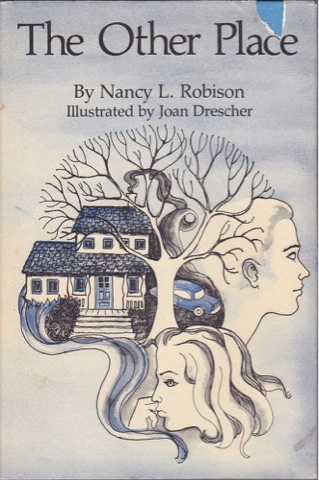 Thanks to him, the Scholastic book catalogue and Arrow Book Club News were on par with the Spiegel's toy catalogue at Christmas. He and my Mom worked together to get the author Nancy Robison to come into our 5th grade class and do a reading from her book "The Other Place," which was like having J.K. Rowling do a Harry Potter scene. I was so star-struck.
 Halloween, 1981, Mr. Koepke dressed up as the anonymous narrator from Poe's "The Telltale Heart," complete with wig, cloak, and ashen makeup. Then, lights off and blinds down, he read the complete text by guttering candlelight, with all the flair of a Broadway show. What we didn't know was that he had a student hiding over in the corner of the room under a desk who was making an increasingly insistent "bum-bump" sound of a heart, creating a truly haunting rendition of the story. Seriously, Vincent Price had nothing on Terry. Whoops! I mean, Mr. Koepke.
 Today, thirty five years later, a whiff of pencil-shavings in an abandoned store-room at the University where I work brought back the world of Mr. Koepke and all the great teachers I've had over the course of my life, and I was filled with such gratitude. We are largely the sum of our experiences, and I feel so blessed to have been cared for and attended to by these giants, and allowed to stand on their shoulders all of my days. It made me realize how many educators there are in my family and the circle of my friends. College professors, special education, elementary, and high school teachers. Even a Principal (Whose permanent record I would dearly love to see). I was suddenly in awe of the company that I keep, and filled with a desire to buy school supplies.