Tuesday, March 27, 2018

How Ya Like Me Now?


In July of 1991, I was compelled by economic circumstances to move with my parents from Long Beach, CA to podunk Kingston, WA. The long-term relationship I was in came to an abrupt end as a concession to the fact that long-distance love affairs are folly. So I packed my guitar, comic books, and heavy heart into my VW Bus, and headed for the world of uncertainty a thousand miles up I-5. My best friend Sean Blake volunteered to go along for the ride without me even asking, for which I was grateful. I think he wanted to cushion the blow and see to it that I landed soft in my new life. He's a good egg like that. 

We were quite the pair, Sean and I. He was a tough-but-folksy-rockabilly type, who would have been at home in The Outsiders; leather jacket, white t-shirt and all. I was at the tail end of my Goth phase, black fingernails, Robert Smith-lite hairdo, and black everything head-to-toe. Together we were the founding douches of the band Sir Lawrence Of Blake Street, aka SLOBS. Our one and only gig had been at the Los Angeles International Airport, where we attempted to stop his girlfriend from leaving on a jet plane with the power of our acoustic guitars and smooth melodies. It went about like you'd expect.

A few hours into our pilgrimage to the great white north, the head on my Bus's engine cracked so we plumed thick clouds of white smoke out behind us continually, as we burned engine-oil like it was going out of style. If the engine weren't in the rear, or if it were water-cooled instead of air-cooled, the trip would have been sidelined immediately. Instead, every time we stopped for gas people saw the miasma of billowing smoke enveloping us and exclaimed that my car was on fire. Which they seemed to find alarming while we were at the gas pump. We just ignored them and added yet another quart of oil to stave off the inevitable heat death of the engine. Pure moxie and the benevolence of a God who loves fools and drunks were our only hope. 

After a ten-hour stint on the road, we stopped for lunch in a southern Oregon backwater called Wolf Creek. It appeared to consist of a restaurant and a boarded-up gas station. If there was more to it than that, it was out where the road disappeared into the trees. We weren't curious enough to find out. Although the restaurant was less than half-full, the American Gothic inn-keepers took one look at us and sat us all the way in the back right next to the kitchen doors, which swung open into my chair. 

The sparsely populated dining hall made it easy to tell when every single one of the children of the corn took their turn staring wordlessly at us. A cultish silence settled on the room, and the ting of cutlery was the only sound as we ate our meal. Our silverware was dirty, the water had floaters in it, the egg-salad was feverishly warm, and the service made it clear that we were as welcome as a couple of bastards at the family reunion. Rather than leave, we made our way into the dingy little lounge kitty-corner to the kitchen to play some pool before getting back on the road.


Like the restaurant side, the tacky, wood-paneled lounge was only moderately full. Maybe a half-dozen good ol’ boys in mesh-back trucker hats and muscle-car T-shirts, all pounding PBR tall-boys at two in the afternoon on a Thursday. But these guests had no compunctions at all about staring, pointing, whispering, and laughing at the two city-slicker goofballs that had obviously stopped in the wrong burg for lunch. The upside to being pariahs in Wolf Creek is that no one wants to join any of your reindeer games, so we had one of the three pool tables to ourselves for the duration.

9-Ball was our preferred game, and Sean and I were about evenly matched, although I got the sense that he let me win a few more than I naturally would have, in deference to my melancholy state of mind.  Especially that day, as I was incessantly mooning over my lost girl with all the subtlety of a chain-saw. The jukebox in the corner of the ratty old joint was braying a continual string of old-school country songs, which wasn’t helping. While Sean was racking for our next game, I went over to see if there might be any more palatable selections available. I wasn't holding my breath. 

To my delight, I saw that mixed in amongst all the Merle, Tammy, Hank, and Reba they had the Bonnie Tyler song "Total Eclipse of the Heart" on tap. I dug for a quarter to put it on. Sean and I played for a bit longer, and then I went back and put the song on again. And then again. There's nothing subtle about it, as it is perhaps the most effective companion for self-pity ever penned. It's also seven minutes long, and I had a bottomless appetite for more.

The tension and annoyance in the room ratcheted up noticeably each time I went to the jukebox, until every move we made was tracked like a ballistic-missile early warning system. It became clear from their glares that if I put it on one more time them good ol' boys was gonna open a can of whoop-ass up on us city-slickers. Still, only when we were damn good and ready did we make our way to the door. On the way out, I dumped every last quarter I had into the juke, calling out "Total Eclipse of the Heart" a dozen more times. 
"I don't know what to do and I'm always in the dark

We're living in a powder-keg and giving off sparks"


How ya like me now, Wolf Creek?!

Monday, March 26, 2018

How Can You Think Otherwise?


“...all we need to do to fix the world’s problems is adjust the feelings attached to them and open up the floor for various identity groups to have their say. All the old, enlightened means of discussion and analysis—from due process to scientific method—are dismissed as being blind to emotional concerns and therefore unfairly skewed toward the interest of straight white males. All that matters is that people are allowed to speak, that their narratives are accepted without question, and that the bad feelings go away.

No one can rebut feelings, and so the only thing left to do is shut down the things that cause distress—no argument, no discussion, just hit the mute button and pretend eliminating discomfort is the same as effecting actual change. So it’s not just that students refuse to countenance uncomfortable ideas—they refuse to engage them, period. Engagement is considered unnecessary, as the immediate, emotional reactions of students contain all the analysis and judgment that sensitive issues demand.”

The above is from an article in Vox magazine published in June of 2015. I read it at the time and copied these two paragraphs, because the line of thinking represented therein really bothered me. Three years later, the paragraphs were still sitting in the Notes app of my iPad, literally the first thing I ever used the app for. Three years later, and I work at a University and have seen first-hand that this line of thinking is alive and well. But yesterday, for the first time, I finally got told to stop Mansplaining (which my autocorrect recognizes as a legitimate word) and that my position as an older (ouch!) white male discredited my argument as to the importance of defining terms correctly when engaging in public debate. The original topic was terrorism vs. mass murder, when is it one or the other? By the time I was shouted-down, it had morphed into whether or not speech itself was violence.

My two primary opponents were a PhD and an attorney, who both made sure I knew the authority that their intellectual pedigree imputed to their otherwise shaky arguments (dissembling, changing the subject, parsing the difference between assault/battery in an analogy I used), before ultimately resorting to a categorical dismissal of my argument based on my identity as a white male. And an old one, at that!

It was disturbing, because we weren’t debating topics like sexism or discrimination, where I would naturally defer to someone’s life experience, rather than rely on simple rhetoric to tell people what they have or haven’t lived through. We were debating the definition of words. Which, theoretically, should have virtually as fixed a value as a mathematical equation, and in any case be unaffected by my cultural identity. The sky is blue, 2+2=4, and violence means violence. If the mouth that those truths comes out of affects a person’s ability to recognize the truth, all is lost.

The title of the Vox article was “I’m a Liberal Professor, and My Liberal Students Terrify Me.” When I went back to read it again, I found that the article has been blacked out by Vox, and you can no longer read it on their site, which I found kind of chilling. But the genie was already out of the bottle and the text of the article, as well as scathing rebuttals to it, are scattered far and wide on the internet. I’ve since read a half-dozen responses to the essay, which excoriated the anonymous professor who wrote it, which I’m sure is why Vox shut it down to begin with. I have been unable to discover who the real Edward Schlosser—the anonymous professor—is, but I’m betting he’s glad that he wrote it under a pseudonym at this point.

Further into the now-censored Vox article, the anonymous professor goes on to analyze a piece in New York Magazine by Liberal commentator Jonathan Chait called “How the Language Police Are Perverting Liberalism,” wherein Chait asks if "the offensiveness of an idea can be determined objectively, or only by recourse to the identity of the person taking offense." Anonymous Vox Professor had this to say in response:

“Here, he's getting at the worry that our judgment of a person's speech hinges more upon their identity signifiers than on their ideas. A sensible response to Chait's question would be that this is a false binary, and that ideas can and should be judged both by the strength of their logic and by the cultural weight afforded to their speaker's identity. Chait appears to believe only the former, and that's kind of ridiculous. Of course someone's social standing affects whether their ideas are considered offensive, or righteous, or even worth listening to. How can you think otherwise?”

When I first read this reply, I was agog. It had never occurred to me that people could even think this way. I can’t believe that I have to say this, but feelings and facts are not the same thing. They do not hold the same weight in debate, education, or the public forum. “But my feelings,” is not a valid response to anyone other than your mother. And it doesn’t matter whether you’re tall or short, skinny or fat, rich or poor, gay or straight, cisgender or non-binary, black, white, yellow, red, brown, or chartreuse.

“…that ideas can and should be judged both by the strength of their logic and by the cultural weight afforded to their speaker's identity. Chait appears to believe only the former, and that's kind of ridiculous… How can you think otherwise?”

I’m sorry, I keep thinking that if I repeat these words over and over again their preposterous nature will become self-evident and self-indicting. Donald Trump may have introduced us to the idiotic term “alternative facts,” but no one gets to have those, any more than they can have an opinion on the boiling point of water. Words mean things. And those definitions don’t change their meaning because you’re triggered, traumatized, or they give you icky feelings.

Now let me be the first to admit that getting shut down in debate because of my race, gender, and age was more than disconcerting. It was more than irritating. It enraged me. But stewing in that rage, I’ve had time to reflect on how others not as “privileged” as me (for lack of a better term) have felt many times throughout their lives. I’m not so tone-deaf as to believe that this is a new or unique experience, and it’s certainly not the first I’ve noticed of it happening in the world. It was just the first time it’s happened to me. Of course I’ve been told to shut up because I was impertinent, inexperienced, or not in possession of all the facts. But never because of who I am.

A couple of days ago, I was in a regularly-scheduled construction planning meeting at the University lead by a woman named Maggie. Having worked with Maggie for two years now, I can say that not only is she accomplished, capable, and educated, but she’s probably the most practical voice in the insane asylum of University politics. She really knows her stuff. Not just the ins and outs of her profession as Head Designer, but the intricacies of negotiating inter-departmental politics and the nuances of interpersonal office relationships. In spite of that, I notice how often she is interrupted or talked over during the meetings she’s leading. 

Now in a room full of construction-types, which is almost exclusively made up of men, there is always going to be jostling and brusqueness, it’s just endemic to the species. You always have to be prepared to stand you ground, and assert yourself to be heard. It’s no place for the thin-skinned. But among themselves, the words of these construction-types bump-up hard against each other with room for nary a breath to pass between, but rarely ride roughshod over the top, like they do with Maggie. She’s a gracious person, and always finds a way to humorously shepherd the conversation back onto track, but the difference between how they treat her and how they treat each other is pretty stark to someone who is paying attention. And this in a room full of men schooled in the rules of PC, which is no doubt mitigating the effect. Nonetheless, it’s still pretty bad.

That people can, with no fear of consequences, tell someone not in a protected group to be quiet because of their identity is proof enough that we’ve swung the pendulum past its tipping point in the other direction. If you can replace the word white with black in a sentence and make it offensive, it must logically be offensive either way. Logic is either a sword that cuts both ways, or else it isn’t logic at all. And the fact that conveniently selective application can now be passed off with a straight face as though it were objective is a sign that the cancer of this line of thinking has metastasized in front of our eyes.

So yeah, it sucked. But it didn’t change the logic of my argument, any more than silencing a person changes their mind. It doesn’t make the silenced wrong, it demonstrates others' fear of what they have to say. It used to be that people insisted on the right to their own opinion. Now we’ve arrived at a time and place in history where people insist on the right to their own facts. How can you think otherwise?

“On hearing their answer, we witness how a civilization begins its collapse. Postmodern academics use the license of the mightier and more insistent to have their way. How often do we hear this mantra?: “I’m a fill-in-the-blank, and I’m very passionate about this issue.” Such declarations have the effect of warning all with a different opinion to shut up, lest they be accused of insensitivity to the other’s feelings. Passion prevails over impotent reason.”

                            —2015 Forbes article “We Have Met the Enemy, and He is Us.”


Wednesday, March 7, 2018

Algorithm & Blues


The story of Facebook’s all-consuming growth is practically the creation myth of the information era. What began as a way to connect with friends at Harvard became a way to connect with people at other elite schools, then at all schools, and then everywhere. In some countries like the Philippines, it effectively is the internet. Currently, the company is valued at over 500 Billion, and all of that is based on a simple but brilliant insight: Humans are social animals, and if you make them feel safe in the cesspool of the internet, they will share obsessively. 

But the machine Zuck built to bring people together is also having the effect of tearing them apart, as well. Study after study has shown that the more time you spend on social media, the unhappier you become. The sense of isolation and inferiority by comparison has been refined to a simple acronym, FOMO. The Feeling Of Missing Out is so prevalent that the acronym is almost always printed without explanation, like LASER or SCUBA. But while other people are posting their greatest hits, gleaned (or even purposefully staged) from a few minutes of their otherwise normal day, you’re stuck with an all-access backstage-pass to the hot mess of your life. Somehow you just know they’re happier, more successful, and more satisfied with their meaningful lives and perfect relationships. Or else they support gay-warming, a climate’s right to choose, bans on assault marriage, and background checks for women’s rights, and that just makes your blood boil! So either way, you hate them. 

Facebook itself is reluctant to do what we’re quick to: blame Facebook for its noted tendency to amplify dissatisfaction. After all, is Facebook really more at fault for amplifying our outrage during the Presidential election than, say, Fox News or MSNBC? You can’t force people to listen to dissent or be balanced on Facebook, any more than you can force them to switch channels between Sean Hannity and Joy Reid. As Andrew Anker, head of Facebook Publishing, has said, “The problem is not Facebook. It’s humans.” But that’s kind of an easy out for them, because while they’re not wrong about that, they’re also not innocent bystanders wringing their hands over what the unwashed savages are doing with poor innocent little Facebook. There are subtle tricks that social media companies use to foster an addiction to their services. And that is what many of us are, addicted.

Emerging brain science teaches us that the consistent firing of neuron groups creates a neighborhood of associated pathways that begin to become default settings for our brains. If they’re allowed (or caused) to fire consistently enough, they begin to erode a rut that reinforces those feelings/choices. Soon, no matter what the situation or environment demands, your brain has become trained to respond in the same way regardless of stimulus. Which is exactly why it's so hard to quit smoking when you're used to that first delicious cigarette and coffee combo first thing in the morning; those neural pathways are used to being the boss and getting their way. Really, it's how almost all addictions work, in some form or another, and I don't think it's a stretch to say that complaining, criticism, and discontent are just as habit-forming in our hearts and minds as any cigarette or drug. 


I began to notice the same effect happening in my own headspace in January of 2017, right after Trump’s inauguration. After two hundred-plus days of a non-stop political shriek-fest, combating fake news, propaganda, and fending off criticism from both sides of the aisle, I had a low-level buzz of discontent going on in the background 24-hours a day. I began to realize how much of my mental energy was being devoted to hostility, negativity, and cynicism. Anyone who knows me knows that sort of mean-spiritedness is the antithesis of who I am at a fundamental level, and I didn't want to permanently become the person I was during the election. As Proverbs warns us, "Above all, guard your heart, for everything you are flows from it.” 

So I purposefully dropped out. 

For the next six weeks, I spent every minute in the real world. Zero news and zero social media. Denzel Washington once famously observed that if you don’t read the paper, you’re uniformed, but if you do read it, your misinformed. I was definitely less informed, but happier and more focused on the issues I care about, rather than trying to correct the internet’s homework by following rabbit trails that lead to irritation and discontent. I didn’t really have an agenda or fixed schedule, other than to take a break to cleanse the pallet. I figured that a month would do, and it eventually became six weeks because at the end of that month, I found that I didn't have anything to say. When my dad had a health scare during a visit to our house, I found my voice again, and returned to find my friends waiting with open arms. It was like coming home after a vacation and seeing your house with new eyes. 

I knew that nothing about America in general, or Fb in specific, had changed in only six weeks. Or if it had, it had probably gotten worse, not better. So if I wanted to retain whatever equilibrium I’d obtained after the fast, my diet would have to be radically altered. Because no matter what Zuckerberg says, Facebook’s solution to whatever Facebook malaise you may be suffering from is to use Facebook more. Contrary to how it may sound, I don’t actually hold that against them.

News feeds have only one job: keep you looking at their site. They’re not doing any of this out of the goodness of their hearts, they need to make money. That’s cool, so do I. So they show you what you want to see, so you'll keep looking, keep coming back. But they don't teach you what you like, YOU teach them that. You may have friends on both sides of the aisle, but if you're seeing a feed heavily biased toward one side, it's because that's who you really are. You click on their links more often (whether or not you put a like on it), you like, comment, and share their stuff more often. You read the whole article they post, watch the whole video, etc. 

The reason people don't like the algorithm is that it's a mirror that shows us who we really are, not who we wish we were. It sees through posturing, virtue signaling, and pontificating because every like, ever click, everything you scroll by without looking at, teaches Fb what you like and what you hate. Over time you see more and less of those things, respectively. If it's empty, contentious, vapid, vitriolic, or meaningless, how does it get that way? No sense blaming Russian bots, filter bubbles, or the Almighty Algorithm. It’s you that teaches them how to treat you.

I've always thought that, like the rest of life, Fb is what we make it. It isn't inherently good or bad, and no one is forcing anything on us. There are no helpless victims of algorithms or the whims of culture, or shadowy overlords brainwashing us. If you learn how to use the controls, you’ll see that nothing could be further from the truth. There are unfriend, unfollow, and take a break for a month features. They're literally just buttons that you push. That's all you have to do. Many people that I know have lame feeds and only see political rants. My feed is art, science, music, comic books, humor, and movies. It was pretty easy to make it that way, but it didn't happen by accident. 

I'm not a hapless victim to whom things are just happening, and neither is anyone else. I built this by design first—by following, unfollowing, and unfriending—and by interaction second. Everything I interact with or ignore teaches the algorithm about me. Everything I comment on, react to, hover over, or click on teaches FB what I want and how to treat me. It definitely helps that I have smart, funny, empathetic friends who give me a lot to work with, but If you want social media to be different, the key is to behave differently while you're here. Build the world, the family, and the life you actually want, and do it on purpose. Here are some strategies to make your time here better.

Connect with the people that you love. Cross paths with them on purpose. You can set up alerts so that you always hear from the people you actually joined Fb to connect with, and never miss anything they post, no matter how mundane. You can choose who you see first at the top of your newsfeed every morning. You know who it is in your life that makes you feel good about yourself, or makes you want to be a better person. Who comforts you, and who challenges you. We all need both kinds of people in our lives, and there are tools to help you cultivate those relationships and interactions here. The more you see of them—and the less you see of that annoying dude you work with —the better.


In addition to specific notices and putting certain people automatically at the top of your newsfeed, you can create Friend Lists to assign people into different groups (High School, Work, Family, Church etc). Then, when you click on that group you’ll see a sort of sub-newsfeed that only has stories from them. There are no ads, except in the sidebar, and no stories from pages that I've liked, or blurbs about how John liked or commented on whatever, which otherwise show up in the main newsfeed. Again, just a couple of clicks to make it happen. 


Another way to cut down on unnecessary offense on social media is to be sure you don't generate any unintentionally. Be sure that you mind the privacy settings on your posts. It's hilarious to everyone except your offensensitive liberal grandma and her church sewing circle. Make sure they don't see it to begin with.


Scroll past all drama, always. You'll soon stop seeing it. You won't have to complain, because it won't be there. You'll have taught the algorithm that you don't give a shit about Trump, your ex-girlfriend, or whatever BS CNN wants you to be afraid of this week. Admittedly, when I came back scrolling past Trump drama was tough, because of its ubiquity, but I found that I was reacting to it the way that someone traumatized does when they return to the scene of the crime. Aversion to to drama can become second nature, and it needs to if you actually want to remain relatively sane.

But better than scrolling past it, is to cut it out entirely. Unfriend, unfollow, or take a break. 

I've unfriended people for a variety of reasons over the years. Mostly it's just because we never talked. I have a similar philosophy throughout all areas my life. Come the New Year, I usually clean house; clothes and belongings I didn't need, want, or use in the previous year go to people who obviously need them more than me. My friend list gets edited, usually shedding a half-dozen or so for similar reasons. I mean, I’m not taking attendance here, I don’t need (or want) a minute by minute recounting of anyone’s life, but if we go a year without a comment, a PM—something—what are we clinging to? There are no points for quantity. 

I’ve also unfriended people for being hateful (against LGBTQ), I’ve reported people for posting things on FB that I thought were over-the-top racist (against First Nation Tribes), and I’ve blocked people that have burned bridges with me in dramatic fashion. To be clear, unfriending someone and blocking them are essentially different levels of the same thing. Unfriending basically turns someone into a stranger. You stop showing up in each other’s newsfeeds, and then have to take the extra step of actually navigating to each other’s pages purposefully, where each will only see whatever the other allows the public-at-large to see. Blocking a person means they’re no longer your friend, and also can’t find you on Facebook at all. They won’t even be able to see your comments in a thread on a mutual friend’s page, even when you’re both in that same conversation. You won’t show up in any searches on Facebook for them, or vice-versa, and you presence will be omitted if they look at a mutual acquaintance’s friend list. Complete invisibility. 

Every time someone makes you afraid, cry, or question your worth, ditch them. You already know the difference between good-natured, productive, healthy, challenging debate being conducted in good faith, and people that are just assholes trying to bring you down. Don't cling to the second kind. Ditch those bitches, and I mean double quick. You don’t have to get back in line to get punched in the face over and over again. Trust that you know the difference between people you disagree with (however vehemently) and bullies who can’t tell the difference between dissenting opinions and evil. People like that are always toxic, even if they happen to agree with you. If they don't take the hint, then block them entirely. They'll soon get tired and look for other distractions from their sad little lives.  


Aside from my yearly Fb housecleaning, I mostly I just unfollow people, rather than unfriending them. I don’t want to lose track of them, I’d still like to be able to check in, wish them happy birthday, drop them a line from time to time. After all, I don’t dislike them, it’s just that the one-note song they're playing gets tiresome. Often, I actually agree with them, but can't stand the monotony of the subject matter or the hysterical shrieking of the opinion. There are volumes on the knob other than 11. Maybe we could use our inside voices? 


When you unfollow someone, they never appear in your feed, but you can still go to their timeline and catch up any time you want. I’ve even got a special friend list for all the people that I’ve unfollowed, just so it’s easy to keep track of them and check in any time I want. In visiting the friends that I've unfollowed, I usually find that I haven't missed much aside from multi-level-marketing sales pitches for candles, and irate political rants. Occasionally, I’ll see that they've built a deck in the back yard, which I do actually find interesting, but I’d have to have waded through 10 posts a day on how Clinton/Trump are the Antichrist to get there. Not worth it. They may be better informed than me, but they certainly aren’t any happier.

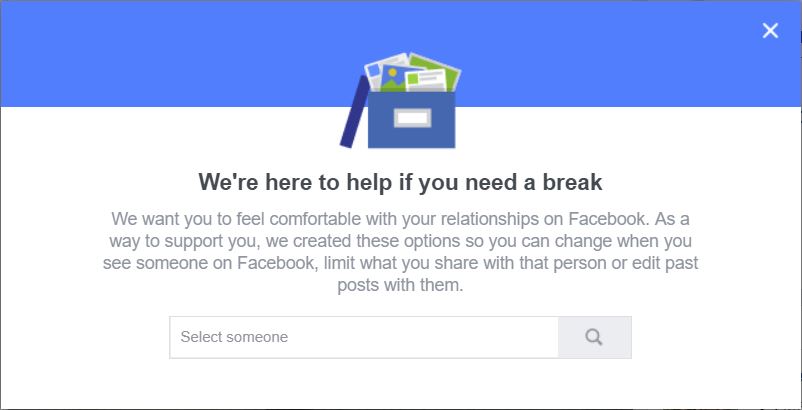
You can even "take a break" from certain people, which will cause them to disappear from your feeds (and you from theirs) for a month. It's like an unfollow that resets itself automatically after a month. Sometimes it can be nice to take a breather from long-winded diatribes like this one. Of course, Fb doesn't alert you when someone unfriends/unfollows you, which I think is for the best. If you don't notice their absence, how close were you to begin with? Whereas if you got the rejection notice, you might actually mistake hurt feelings for giving a damn in the first place. I’m sure a few people have unfriended me over the years, unbeknownst to me. I only know of one, and when I discovered her reasoning I was glad to be shut of her. I don’t need that kind of crazy in my orbit.


And lastly, take a break from all social media once in a while. Even a week off can do wonders for your outlook, and remind you of what you actually care about, which battles are worth waging, and which to pass by. When you're here, curate your newsfeed. Unlike/unfollow pages that only make you mad, even if you agree with them. You don't need to have outrage ratified and reinforced. Stoking those fires doesn't change the world, but it does change you. And not for the better. Instead, organize with positive people to engage in constructive political action/dialogue. Find a comedy page, or a musician, or a literary journal to follow. Indulge in your hobbies and passions by finding like-minded people who surf, or do woodworking, or make jewelry, and let them wow you. Come to social media purposefully and use it well, to your benefit, instead of being used by it to amplify divisions, dissatisfaction, and isolation. 

When I first joined Facebook in 2012, I thought it would be an orderly Algonquin Roundtable, an exchange of ideas, culture, and art. The digital Areopagus. Imagine my disappointment. But we have more choices, and more ability to make it what we want than ever before, and I wrote this to help people sort it out.  Because if we don’t get this under control, my fear is that perma-rage will become (if it hasn't already) a way of life for Americans, as it was becoming for me. The long-term effects of that are not something I'd like to see. To a hammer, everything looks like a nail; to the offended, everything is a reason to become more so.


Sunday, December 31, 2017

Focus


“Think fast!” Joe says out of nowhere.

Joe is the Joest Joe in the history of Joe-dom. There has never been a Joe as Joe-ish as Joe Perruccio. He’s built like a fireplug; squat, but all shoulders with cinderblock hands and a considerable thatch of Disco-level chest hair escaping the collar of his tacky Hawaiian shirt. He’s got a Bruce Willis receding-hairline, and just has to be from Jersey or New York with that accent. Right now we’re driving up Shell Hill in Long Beach, the steepest incline in the city, made legendary by the routine deaths of skateboarders and bicyclists who brave the slope every year. It’s like going up that first steep rise on a roller coaster, just chinking along one link at a time. My inner ear is telling me we’re about to fall over backward, and that only the space shuttle should point directly skyward as we are. 

Which is why I find it so alarming when Joe reaches over from the passenger seat and turns the key to the OFF position and pulls it straight out of the ignition.

I instantly jam my foot down on the brake, only to discover that a Reliant K has power brakes and steering, which do not function when the ignition is in the OFF position. The pedal is unyielding as stone and the steering wheel has become inert in my white-knuckled hands. I don’t have time to wonder what the hell Joe is playing at before my hands and feet begin to act entirely on their own, with knowledge I didn’t know they possessed. My left foot hammers the parking brake into the firewall, while my right hand shoves the drive selector into park, and then both feet stand on the frozen brake pedal, leveraging my hands against the useless wheel, forcing the pedal down maybe half an inch. I turn to look at Joe, out of my seat and fully standing on the brake. He’s smiling at me from under an epic moustache, his chuckle a low rumble like distant thunder.

“Just wanted to see what you had in you, chief,” he says, and hands the key back to me. “Not bad.”

At that, I look around and realize that I’d instinctively done exactly what I was supposed to do; the car is stopped and resting "safely" on the fifty-degree incline. No one is more surprised than me. When class began three weeks ago, I was literally the worst driver anyone had ever seen. When I got behind the wheel, the other three students in the back seat held their collective breath, and I was often the reason for their gasps of barely-restrained terror. At fifteen, I was the only one of the students to have absolutely no experience behind the wheel. The rest were taking this Summer Driver’s Ed class—offered through our High School—as a perfunctory training to qualify for their license. They’d all been driving with their parents for months already. 

On the other hand, I got my permit the day before class began. No experience of any kind. I’d never even started the car to warm it up. Nothing. So for example, I didn’t realize that when one turns the wheel to take a corner, you must turn it back to straighten out. Apparently, they do not autocorrect as I’d somehow expected. Consequently, my early turns were usually somewhere around ninety-four degrees, and often involved encounters with curbs and innocent garbage cans. After three weeks of training in the “state of the art” simulator—housed in a double-wide trailer behind the gym—and some truly terrifying outings onto the streets, I’d finally earned the trust of Joe Perruccio.

It dawns on me that Joe has a brake on the floorboard of his passenger-side seat in the specially-outfitted K Car Training Vehicle, so we were never in any real danger. I should probably be a little more pissed than I am, but his approbation is hard to come by. He doesn’t just give those “not-bads” away. Usually, silence was the best you could hope for. Add to the fact that he didn’t try that stunt on anyone of the other students and it finally occurs to me, this was actually a compliment of sorts. 

Joe is probably the coolest teacher in school, and Poly’s most celebrated baseball coach, too. But the fact that he was the only person in the vehicle to never break character, is the real reason I look up to him. He’s my Social Studies teacher during the school year, and was the kind of guy who had students show up in his class at lunch to eat, hang out, and episodically watch the R-Rated action movie of the week. Predator, Lethal Weapon, etc. He cussed in class routinely, but conversely had a very serious Catholic-based code of honor that he enforced strictly. You could say “damn” but not “goddamn.” He never seemed to pay attention to what the class was doing while he was grading papers, but would often walk the rows of desks looking over our work. A few times he threw people’s backpacks out the 2nd floor window if they were sleeping in class or were turned around talking to someone when they should have been minding their business.

One time, as he was stalking the rows, Joe discovered that a kid named Frank had brought a gun to school. He caught just a glimpse of the chrome .44 from down inside Frank’s backpack and then moved like lightning. Joe grabbed the bag first, and then Frank, and hauled him up out of his desk one handed like he was a feather. Joe was a former longshoreman and, with that gravelly baritone and noir-ish, hardboiled Mike Hammer-demeanor, for a second I thought both Frank and his backpack were going out the window. Because even though he was a teacher now, he still had the instincts and the stones to deal with a problem the roughneck way, like a Union Man should. Who knows what might have happened if he hadn’t?


Not sure why a hardcase like that would choose to become a teacher, especially on the heels of a lucrative union job. Could be he was in witness protection, or otherwise on the lam? I liked to think that maybe he’d killed a man. What can I say? I’m a romantic. He was a study in contradictions. Often terse, but loquacious when we got him off-subject, usually about some bar-fight he’d been in, or a skank what done him wrong.

But if he saw you about to make a dumb mistake in life, he went from a Guido to a proverb-spouting Yoda who’d occasionally refer to you as “Dumbass.” Usually because you were being a dumbass. He wasn’t above an endearing cuff upside the back of a guy’s head while he did it either. But he was always kindly and protective to the girls in class, often exhorting them dress and behave modestly, because boys only had one thing on their mind. When he was walking the rows, if he caught a guy with a comic book or a Playboy he’d tell him to put it away and focus, without embarrassing him. But when he caught me drawing pentagrams in my notebook and filling them with arcane Latin incantations, he ripped the sheet right out of my binder, held it up high and quite loudly inquired, “What the fuck is this?” 

So… tits and ass? Cool. The Devil? Not cool. Got it. Credit where it’s due, it did end the witchcraft phase of my life pretty much instantly.

I remember some of what we studied in class, but everything about the K-Car. Especially the times he told the candy-asses in the back seat to shut the fuck up while I was driving. Yeah, that was alright. While everyone else’s freeway test consisted of merging into one lane of traffic and then getting off at the next exit, Joe had me get all the way over into the fast lane to pass a bunch of cars in midmorning LA traffic, pushing it to almost 90, which is practically a miracle in an ’82 K Car. By the time we were done, I got my license with a 97 on the DMV driving test, by far the highest in the class. Thanks, Joe.


Within the year, I’d become quite the daredevil driver, my spatial judgment and reflexes making me a natural. Playing car tag with my buddy Phillip; outrunning cops and gangsters when we got ourselves into tight spots (which we did with alarming regularity); drifting through crazy turns riding the E-brake, mastering the old Starski and Hutch reverse power-slalom move. From humble beginnings to Fast and Furious in three easy steps. Not sure how he would have felt about me using those skills to ditch the cops so many times in my teens and twenties. Part of me thinks he would have said, “Nice one, chief.” But then I can also hear him calling me a Dumbass and telling me to respect authority, too. Joe’s passed away now, so I guess I’ll never know. 


I’m grateful though, because just this past Winter, as I was taking a cloverleaf exit from one freeway to another, all four of the wheels on our Camry lost traction with the oily, rain-slick pavement at the same time, and I took the old grocery-getter through the arc of the cloverleaf while pin-wheeling around backward. At the last second, I flipped the nose back around in the right direction two feet from the guardrail I was about to slam into. Never even came to a stop, just powered out of the backward slide and slalomed back into the lane. My hands and feet just did what they do, faster than a thought could go through my head. I saw on the news that day there were three wrecks at that same spot, one of which was a cop responding a previous accident, and winding up in one itself. Thanks, Joe. 

I guess the thing that stands out the most were his little aphorisms and insults. “Fell out the ugly tree, and hit every branch on the way down.” “Bad company corrupts good character.” “The Devil finds work for idle hands.” “Your mama got so many double chins she needs a bookmark to find her mouth.” “The truth will set you free. But first it will piss you off.” He was an endless repository of shit like that, which I always imagined him learning at the knee of his Mema—some hard-boiled, chain-smoking matriarch on the stoop of a Brooklyn tenement, as she cuffed him on the back of the head from time to time, for good measure. Probably while calling him Dumbass.

Of all Joe’s boilerplate proverbs, only one ever really made any difference to me: “Your focus determines your direction.” He didn’t mean it as a philosophical sentiment, but literally. Keeping the car headed straight, hands at ten and two, if you look out either side window for a count of five, invariably the car begins to slowly drift in that direction, no matter your efforts to the contrary. You move toward what you’re focusing on. Want it or not, like it or not.


I’d just about lost that thought to the sands of time, until I walked into a Church in Seattle, twenty years later. There, emblazoned in huge letters on the wall, were Joe’s words: “Your focus determines your direction.” Pretty sure it’s nowhere in the Good Book, but truth is truth, and it brought back that gruff, endearing old crowbar of a man with a wistful pang for the years gone by. It was odd realizing that I’d reached the age that Joe had been when he said those words in the old K-Car. I didn’t feel anywhere near as wise as he’d seemed to me then. Still don’t. But if I’ve gleaned any insight at all down the span of those years, it’s that nobody really knows what’s going on, and leadership is really just the ability to disguise your panic. We’re all pretending, clinging to traditions and folksy sayings, hoping for the best. Who knows, maybe Joe was, too? 

Then again, Joe sent twenty-six ball-players to the Majors, and one to the Hall of Fame. So maybe not.

“Your focus determines your direction.” I’ve thought about those words often since Seattle. Especially when the going was rough, when life seemed unfair, and the world threatening. I’ve just finished an especially challenging season, years filled with days like that. Hard disappointments, awful clients, dishonest business associates, and outright betrayals from longtime friends and mentors. Another dream down in flames. All things considered, a pretty awful chapter in life.

Or was it?

I mean, sure, my business broke up, but somehow the lights stayed on at my house. I found out that I’ve surpassed two of my mentors in terms of skill and integrity, and when my back was against the wall—the same as theirs before me—I made the choices that cost me dearly, while they just stole from people and moved on. And as bad a feeling as that truly is, finding out what you’re really made of is priceless. 

Joe used to say that in boxing, “Everybody's got a plan, until they get punched in the mouth.” Looking back, I think it means that we’d all like to think we’d make the right choice, but you never know who you really are until you’re down in it, and actually taking punches for real. I used to think that God brought tests into my life to see what I’m made of, but recently it’s occurred to me that who I am is no surprise to Him. Sometimes it is to me though, so maybe those tests are to show me who I really am instead. In spite of some pretty punishing challenges, I have to say I’m glad to have met the guy I was hoping I’d be.

“When you stop expecting life to be easy, it gets a lot easier,” Joe used to say. It’s easy to focus on all the negative things that happen in our lives. The monumental disappointment of losing my business, or all the travails it involved to begin with: Court proceedings to collect from some dirtbag clients who never even had the money to finish the project; or the trusted mentor who embezzled from us; the bungling morons at the IRS who wrongly seized the balance in our company bank account and virtually ruined us. The list of woes is as endless as I choose to make it. Or I could take a page from Joe’s book and say to myself, “The guy with no shoes complains until he meets the guy with no feet.” 

That same demoralizing season was also rife with surprising dividends I could never have predicted. I’ve renewed age-old friendships that I would have said were irrevocably lost to the ash heap of time and bad choices. I’ve seen the smiling faces, heard the sweet voices, and held in my arms those that I would have sworn I would never see again in this life. I come home every day to a house that resounds with laughter and love. And that’s either the metric you evaluate your life by, or it isn’t.

Right after I broke up with the first semi-serious (three whole months!) girl I dated in High School, Joe told me this story:

Two farmers met weekly at their fence. The first farmer says, “Heard your son fell from his horse and broke his arm. That’s terrible!” The second responded, “Who can say?” The following week the first says, “I heard the king is conscripting men for war with the neighboring kingdom. It’s good your son has a broken arm and cannot go off to war.” “Who can say?” the second responds. And again, “The war went well, and the men are already on their way home with an impressive load of spoils. A shame your son will bring none to you.” “Who can say?” says the second. Finally, “The king and army were set upon by ambush, ransacked for their treasure and killed to a man. How fortunate your son wasn’t with them after all!” 

“Who can say?” 

I’ve kept that one in my back pocket all these years, because I’ve almost always found that, in retrospect, the worst patches of my life were often a goldmine, yielding unexpected treasures of wisdom, patience, and humor. Not to mention some great stories to write about. During those seasons, there wasn’t anything I wouldn’t have given to fast forward through to a smoother piece of real estate. But afterward, those periods became precious memories of the people, places, and times that taught me who I am. Trophies that I wouldn’t trade for love or money. Like Joe used to say, “It’s good for you. Puts hair on your chest.”  

And he would know. My God, that man had a lot of chest hair. 


There’s no doubt that experience is a cruel teacher. The test comes first, and then the lesson. But if history is any indicator, the day is coming when even that dark season will be all sepia tints and fond nostalgia. Like a badge of honor from the moment my mettle was tested and, by God, I passed. I guess it kind of depends on what I choose to focus on. While I’m pretty happy to have that patch of ground in my rearview, all things considered, I still believe that our best days lie ahead of us. As for the last chapter, perhaps it can still be redeemed. It might be that I’ll look back one day and number them among the best years of my life. 

Who can say?